top of page
CLARICE PRANYOTO

Robot Jarvis
Mechatronics Final Project
With Avani N, Eric O, Manasa D
Overview


Jarvis, an autonomous electromechanical robot for a competitive field-navigation challenge. The robot was required to localize itself, navigate around obstacles, and autonomously score field targets. Our final system combined a two-level mechanical chassis, motorized differential drive, embedded sensing, and wireless communication. Jarvis used encoder-based dead reckoning, TOF wall following, and servo-based actuation. During competition, the robot’s speed and mechanical robustness became major advantages, allowing it to quickly reach targets, climb the ramp, and play effective defense against other robots.
Electrical Design

The main PCB controlled the DC motors, time-of-flight sensors, servo, and I2C communication. 2 DC motors were driven through an L298N motor driver and powered by a separate LiPo battery, while the servo used its own 6.4–7 V supply.
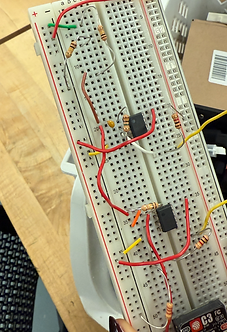
The localization system was on an isolated PCB to reduce electrical noise and protect the signal-conditioning circuit. The Vive circuit amplified IR photodiode signals using a two-stage op-amp design field positioning and orientation estimation.
A major challenge was translating breadboarded circuits into reliable soldered perfboard assemblies, which required continuity checks, voltage probing, and more intentional wire routing.
_edited.png)
_edited.jpg)

Validating op-amp with a function generator
Introducing IR photodiode
Final PCB
Software Design

Manual Control


Autonomous Control
bottom of page